
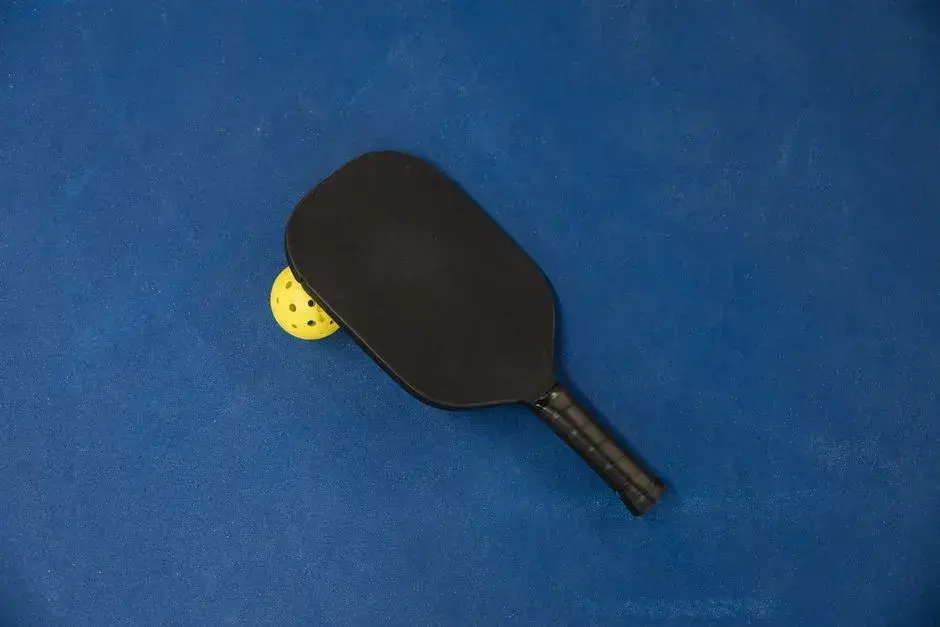
What is pickleball? A paddle sport born in 1965
What is pickleball? A paddle sport that mixes tennis, badminton and table tennis, invented in 1965. How it plays, and where to try it on Koh Samui.
Updated on 2 November 2026.
Summary: What is pickleball? It is a paddle sport played on a small court with a solid paddle and a light plastic ball full of holes, mixing elements of tennis, badminton and table tennis. It was invented in 1965 in the United States, it is easy to learn in a single session, and it is now the fastest growing sport in America.
What is pickleball, and why does everyone suddenly seem to be talking about it? The short version: it is a racket sport for two or four players, played on a court the size of a badminton court, with a solid paddle instead of a strung racket and a perforated plastic ball that flies slower than a tennis ball. Most people can rally on their first visit, which is exactly why it spreads so quickly from one friend group to the next.
This guide is written for the curious newcomer: the traveller who has seen the word on a sign, the resident who has heard friends mention it, the tennis player wondering if it is "real" sport. It covers the history of the game, how a point works, the kit you need, how it compares with other racket sports and why it has become so popular. If you want to try it in Lamai, our pickleball club page explains what Shi Shi Samui is preparing.
In this article
- What is pickleball in two lines
- Where the game came from
- How a point actually works
- Paddles, balls and what to wear
- How it compares with other racket sports
- Why it has become so popular
- What we hear about pickleball in Lamai
- Who the game suits best
- Trying pickleball on Koh Samui
- Frequently asked questions
What is pickleball in two lines
Pickleball is a net sport that borrows the court of badminton, the low net and scoring logic of tennis, and the solid paddle of table tennis, then slows everything down with a plastic ball. It is played in singles or doubles, and doubles is by far the most common format.
That is the whole idea in a sentence, and it explains the appeal. The court is small enough that you do not spend the game sprinting, the ball is slow enough that beginners can return it, and the rules reward placement and patience more than raw power. A teenager and a grandparent can share a court and both enjoy the match, which is rare among racket sports.
Where the game came from
The history of pickleball starts on a summer afternoon with a missing piece of equipment. According to the Washington State Legislature, the sport was invented in 1965 on Bainbridge Island, near Seattle, by Joel Pritchard, Bill Bell and Barney McCallum. Their families wanted to play badminton, could not find a full set, and improvised with ping-pong paddles, a net and a neighbour's plastic wiffle ball.
Pritchard later became lieutenant governor of Washington and a member of Congress, and the game he helped invent outgrew the backyard. The same state record notes that pickleball was named the official state sport of Washington in 2022, almost six decades after that first improvised rally.
Why is it called pickleball?
Nobody agrees, and the debate is part of the folklore. One version links the name to the rowing term "pickle boat", the crew made up of leftover oarsmen from other boats, which suited a game assembled from leftover equipment. The other version credits the Pritchard family dog, Pickles, who supposedly chased the ball. Most histories favour the rowing story, but the dog version is the one players repeat on court, so you will hear both.
How a point actually works
You do not need to learn a rulebook to play your first game, but five ideas make everything else make sense.
- The serve: it is hit underhand, below the waist, diagonally into the opposite service box. No overhead smash to start the point, which levels the field for beginners.
- The two-bounce rule: the receiving side must let the serve bounce, and the serving side must then let the return bounce. Only after those two bounces can anyone volley.
- The kitchen: a zone of seven feet on each side of the net where you cannot volley. It stops players from camping at the net and smashing every ball.
- Scoring: games are usually played to 11, won by two points, and in the traditional format only the serving side can score.
- Doubles rotation: in doubles both partners serve before the serve passes to the other team, which is why you hear three numbers called before each serve.
These are the essentials, not the full set of pickleball rules. To read more about faults, line calls and the classic beginner mistakes, see our guide to pickleball rules, which walks through each one with examples.
What makes the game feel different from tennis is the soft middle phase. Once all four players reach the kitchen line, rallies turn into a patient exchange of short, low shots called dinks, each player waiting for a ball that sits up high enough to attack. That is where most points are won, and it is a skill that has little to do with strength.
Paddles, balls and what to wear
Pickleball is played with a solid paddle, larger than a table tennis bat and smaller than a tennis racket, with no strings. Early paddles were plywood; modern ones use a honeycomb polymer core with a composite or graphite face. A heavier paddle gives more power and stability, a lighter one gives faster hands at the net. For a first game, any mid-weight model is fine.
The ball is hard plastic with round holes. Outdoor balls have smaller, more numerous holes and are a little heavier, so the wind moves them less; indoor balls are softer and slightly slower. On a hot, breezy island the difference is noticeable, and outdoor balls are the usual choice.
For clothing, think tennis rather than gym: light breathable kit, a cap, and above all proper court shoes with lateral support. Running shoes are built to go forward, and pickleball is a game of short sideways steps.

How it compares with other racket sports
The question "what is pickleball closest to?" comes up constantly, because the game genuinely sits between several others. It takes elements of tennis, badminton and table tennis, but it does not play like any of them. The table below compares the formats rather than any particular club.
| Sport | Court | Equipment | How you start a point | Time to first real rally |
|---|---|---|---|---|
| Pickleball | 13.41 m by 6.10 m, low net | Solid paddle, perforated plastic ball | Underhand serve, diagonal | One session |
| Tennis | 23.77 m by 10.97 m for doubles | Strung racket, felt ball | Overhead serve | Several lessons |
| Padel | 20 m by 10 m, glass walls | Perforated solid racket, pressurised ball | Underhand serve after a bounce | One or two sessions |
| Badminton | Same footprint as pickleball, high net | Light strung racket, shuttlecock | Underhand serve | One session |
| Table tennis | A table, 2.74 m by 1.525 m | Small bat with rubber, light plastic ball | Serve from an open palm | A few sessions to control spin |
The comparison that interests most people on the island is pickleball against padel, since both arrived recently and both are sold as easy. We have written a full piece on pickleball vs padel that goes through court size, cost, joints and learning curve.
Against tennis, the gap is mostly about space and time. A doubles tennis court covers roughly three times the area, the ball travels much faster and a beginner spends most of the first lessons collecting balls. On a pickleball court the ball stays in play, and that is what makes the first hour fun rather than frustrating.
Why it has become so popular
The numbers explain the noise. According to the Sports and Fitness Industry Association (SFIA, 2026), 24.3 million Americans aged six and over played pickleball in 2025, up from 4.2 million in 2020. The same report describes it as America's fastest growing sport for five consecutive years, which is why the phrase "pickleball fastest growing sport" appears in almost every article on the subject.
According to the same SFIA figures, women accounted for 42.9% of participants in 2025, up from 38.6% in 2020, and teenagers and young adults aged 13 to 24 now show the highest participation rates of any age group. That last point surprises people who still picture pickleball as a retirement pastime.
Three things drive this growth, and none of them is marketing:
- Low barrier: a paddle and a ball cost little, and a newcomer is rallying in minutes.
- Mixed levels: strong and weak players can share a doubles game without it falling apart.
- The social side: courts are close together, games are short and players rotate, so people meet each other.
Whether pickleball keeps growing at the same pace matters less to a beginner than the simple fact that it is now one of the most widely played paddle sports in the world, with courts appearing in holiday destinations far from its American origins.
What we hear about pickleball in Lamai
At Shi Shi Samui, What is pickleball? is one of the questions guests actually put to us, alongside Do I need to be a member? and Can I rent equipment? This guide is our long answer to the first one. The other two have short answers: no membership is needed, and paddles and balls are provided on site.
We see that most players on the island are still looking for somewhere to play regularly, because dedicated courts remain rare on Koh Samui. That is the gap our club wants to fill. We are preparing dedicated pickleball courts in Lamai, open to members and day visitors, with beginner clinics and open play planned so that a first-timer and a seasoned player can both find a game. Our aim is simple: a regular game for residents, and one memorable hour on court for travellers.
Who the game suits best
Pickleball is a good fit for more people than most racket sports, but some profiles take to it faster than others.
- Complete beginners: the slow ball and underhand serve mean you play real points in your first session.
- Former tennis players: your footwork and court sense transfer directly, and the kitchen adds a new tactical layer.
- Couples and friends of different levels: doubles hides the gap between a stronger and a weaker player.
- Travellers on a short stay: an hour is enough to learn, play and enjoy it, no course to book in advance.
- Residents after a regular game: the social format makes it easy to find partners once you know a few faces.
It suits people less if they want a high-intensity cardio workout every time. Pickleball can be fast at a good level, but a casual game is gentler than singles tennis. If your goal is pure fitness, a session in our fitness gym in Lamai alongside your games is the better plan.
Trying pickleball on Koh Samui
Shi Shi Samui is a sports and social club in Lamai, on the south-east coast of Koh Samui, open seven days a week to members and day visitors alike. We are preparing dedicated pickleball courts, which open soon, and we plan beginner clinics and open play to cover the serve, the kitchen and scoring, then social tournaments once the courts are running. Beginners are welcome, and no racket background is needed.
Pickleball booking is not open online yet. To be told as soon as the courts open, send us a message through our contact and location page. In the meantime, our tennis court in Lamai is available at 600 ฿ per hour, and all current rates are listed on our prices page.
Frequently asked questions
What is pickleball in simple terms?
Pickleball is a paddle sport played on a badminton-sized court with a low net, a solid paddle and a light plastic ball with holes. Two or four players hit the ball over the net, serving underhand, and games usually go to 11 points. It combines ideas from tennis, badminton and table tennis, and most beginners can rally within their first hour on court.
Is pickleball a good sport?
Yes, for most people it is an excellent sport. It is easy to start, social, and rewarding at every level, from a first rally to competitive doubles. The small court means less running than tennis, while the quick exchanges at the net still keep you moving. It is also one of the few racket sports where players of very different levels can enjoy the same game.
What is the difference between pickleball paddles?
Paddles differ mainly in weight, core material, surface and shape. Heavier paddles add power and stability, lighter ones are quicker at the net. Polymer honeycomb cores are softer and give more control, while graphite or carbon faces add grip on the ball. Longer, narrower paddles give extra reach but a smaller sweet spot. Beginners do well with a standard mid-weight model.
What is the new sport replacing pickleball?
No sport is replacing pickleball. Padel is the name most often mentioned, and it is growing quickly too, but the two attract different players: padel uses walls and a pressurised ball, pickleball a low net and a plastic ball. According to the SFIA, pickleball was still the fastest growing sport in America in 2025, for the fifth year running.
How can I learn to play pickleball?
The fastest way is a short beginner session on a real court with someone who knows the rules. Online videos help you picture the serve, the two-bounce rule and the kitchen, but one hour of play teaches more than any tutorial. Start in doubles, keep your serve simple and focus on getting the ball back softly rather than hitting hard.
Do I need to be a member to play pickleball at Shi Shi Samui?
No. Shi Shi Samui is open to day visitors as well as members, so you can come for a single session during a holiday without signing up for anything. The club supplies the equipment, so there is nothing to bring. The courts are opening soon: contact the club to be told when pickleball sessions start, and check the prices page for current rates.
Paul Cosnier, Director at Shi Shi Samui (about the club).
Enjoyed this article?
Browse our other guides or get in touch to plan your stay.